




A Complete Guide to 3.7 Volt Battery Sizes
Quick Answer:
What Are the Common 3.7V Battery Sizes?
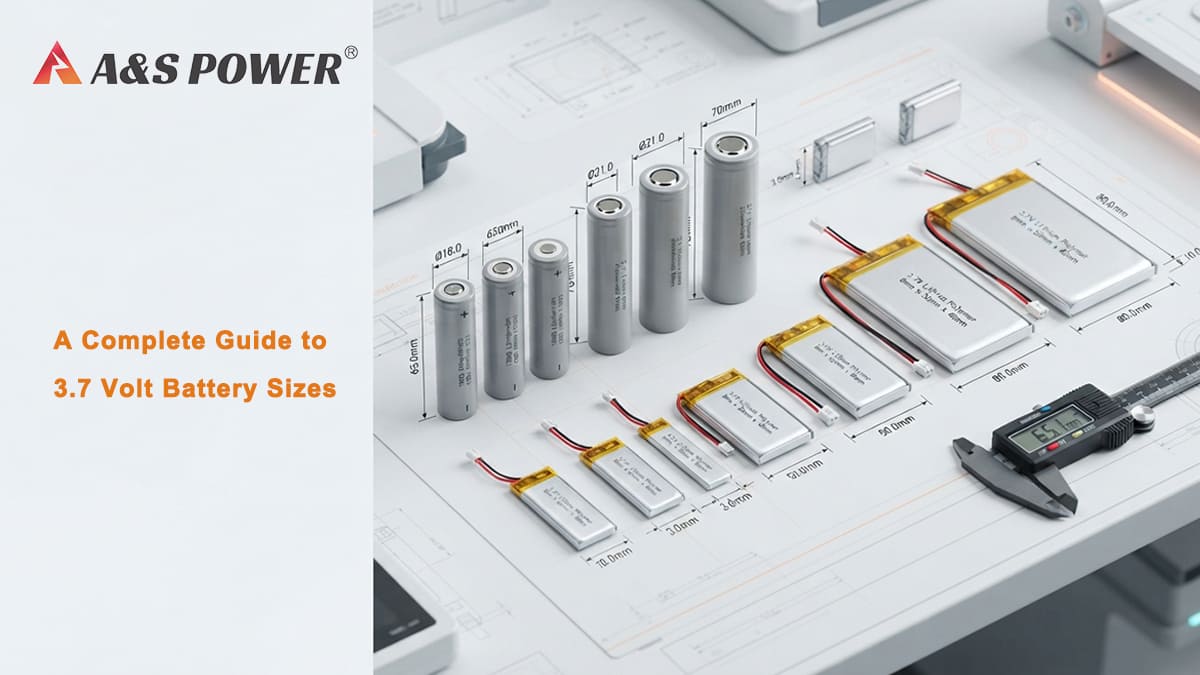
Common 3.7V lithium-ion battery sizes include 14500, 16500, 18350, 18500, 18650, 21700, and 26650 cylindrical cells. For LiPo batteries, there is no single standardized size. Manufacturers can produce different thicknesses, widths, and lengths according to the product's available space.
For example, a typical 18650 cell is approximately 18 mm in diameter and 65 mm long, while a typical 21700 cell is approximately 21 mm in diameter and 70 mm long. Both are commonly specified around 3.6–3.7V nominal voltage.
For compact electronic products, I often consider LiPo pouch cells because their dimensions can be customized much more freely than cylindrical cells.
Introduction
When I work with engineers on a new battery-powered product, one of the first questions is usually simple: What size 3.7V battery do I need?
The difficult part is that there is no single standard “3.7V battery size.” A 3.7V battery can be a cylindrical lithium-ion cell such as an 18650 or 21700, or it can be a flat lithium polymer (LiPo) pouch battery with a highly customized length, width, and thickness.
That distinction matters when designing products such as GPS trackers, medical devices, wearables, portable electronics, IoT equipment, and industrial instruments.
In this guide, I will explain the most common 3.7V battery sizes, how battery size codes work, how dimensions relate to capacity, and when a standard cylindrical cell or custom LiPo battery makes more sense.
What Does 3.7V Mean on a Battery?
Before comparing battery sizes, it is important to understand what the “3.7V” label actually means.
A 3.7V lithium battery is normally referring to its nominal voltage, not the voltage measured at every point during operation.
A typical single-cell lithium-ion or lithium polymer battery may have:
| Battery state | Typical voltage |
|---|---|
| Nominal voltage | 3.6–3.7V |
| Fully charged | About 4.2V |
| Discharge region | Approximately 3.0–4.2V |
The exact voltage limits depend on the cell chemistry and manufacturer's specification, so I always recommend using the battery datasheet rather than assuming every lithium cell has identical limits.
A&S Power, for example, specifies its AS502030 LiPo cell at 3.7V nominal voltage with a 3.00V discharge cut-off and a 4.2V charging voltage.
This is why measuring approximately 4.2V on a fully charged “3.7V battery” is not necessarily a problem. The 3.7V figure is a nominal rating.
Common 3.7V Cylindrical Battery Sizes
Cylindrical lithium-ion batteries use relatively recognizable size codes. In many common formats, the first two digits indicate the approximate diameter in millimeters, while the following three digits indicate the approximate length.
For example, “18650” generally refers to approximately 18 mm diameter and 65 mm length. However, the actual dimensions can vary slightly depending on construction, terminals, insulation, and protection components.
Here are several commonly encountered sizes:
| Battery size | Approx. diameter | Approx. length | Typical nominal voltage | Common use |
| 14500 | 14 mm | 50 mm | 3.7V | Compact electronics |
| 16500 | 16 mm | 50 mm | 3.7V | Portable equipment |
| 18350 | 18 mm | 35 mm | 3.7V | Compact high-power devices |
| 18500 | 18 mm | 50 mm | 3.7V | Electronics and battery packs |
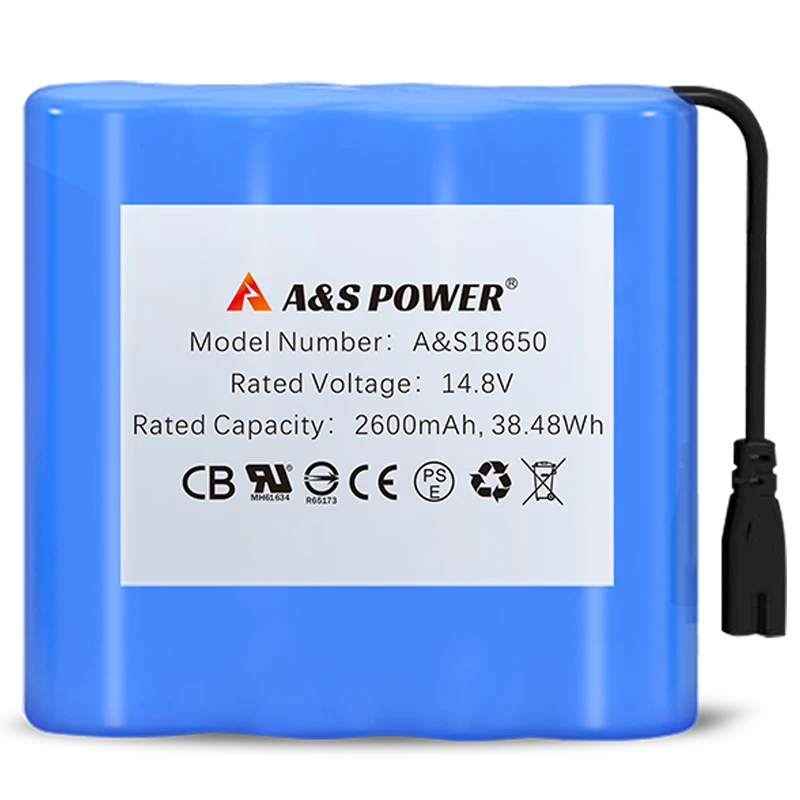
| 18650 | 18 mm | 65 mm | 3.6–3.7V | Power tools, electronics, packs |
| 21700 | 21 mm | 70 mm | 3.6–3.7V | High-capacity applications |
| 26650 | 26 mm | 65 mm | Around 3.6V | High-capacity applications |
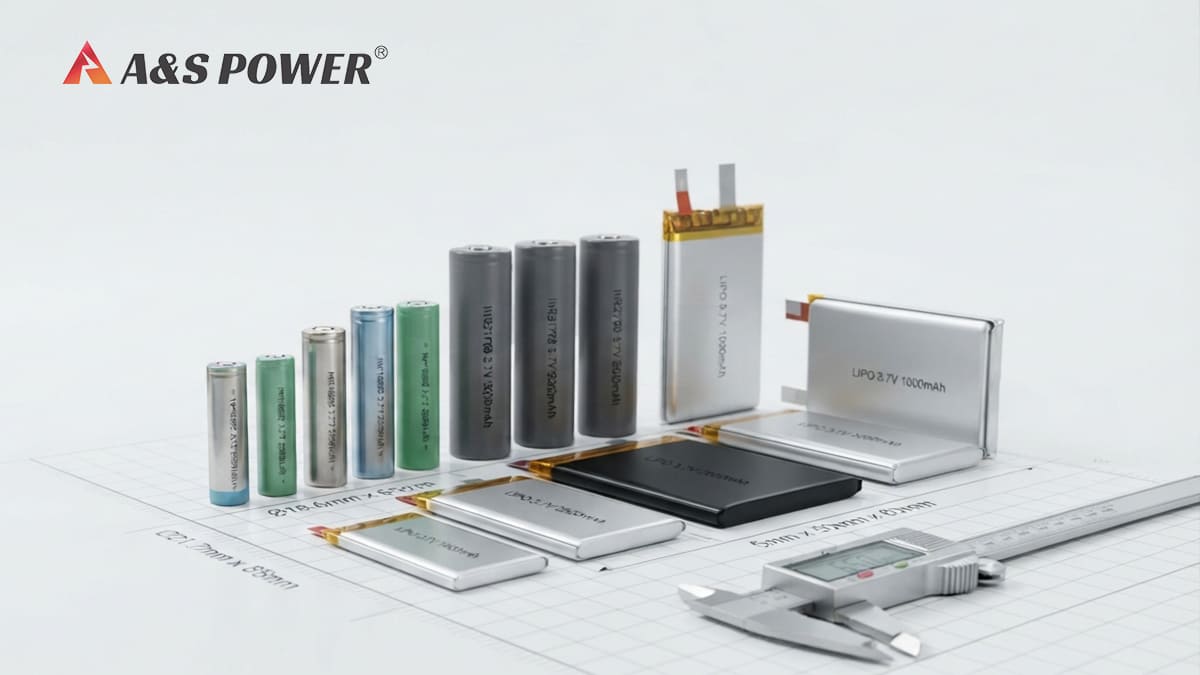
Published battery catalogs show, for example, 18650 cells around 18 × 65 mm and 21700 cells around 21 × 70 mm, with capacities varying according to the cell design.
The important point is that physical size does not determine capacity by itself. Cell chemistry, electrode design, energy density, and allowable discharge rate also affect the final specification.
18650 vs. 21700: Which 3.7V Size Is Better?
The 18650 is one of the most widely recognized cylindrical lithium-ion formats. Its relatively compact 18 × 65 mm form factor makes it practical for many battery packs.
The 21700 format is larger at approximately 21 × 70 mm. Because it has more physical volume, it can support higher capacity in many cell designs.
A simplified comparison looks like this:
| Feature | 18650 | 21700 |
| Approx. diameter | 18 mm | 21 mm |
| Approx. length | 65 mm | 70 mm |
| Typical capacity range | Varies by cell | Varies by cell |
| Space requirement | Lower | Higher |
| Potential capacity per cell | Lower | Generally higher |
| Suitable for compact packs | Yes | When more space is available |
I would not automatically choose a 21700 simply because it can offer more capacity. The correct choice depends on the enclosure, current demand, thermal conditions, required runtime, pack configuration, and manufacturing cost.
3.7V LiPo Battery Sizes Are Much More Flexible
This is where lithium polymer batteries are fundamentally different from cylindrical cells.
A LiPo battery uses a pouch structure, so manufacturers can produce cells in many different rectangular dimensions. There is no universal equivalent of the 18650 size code for all LiPo batteries.
For example, A&S Power lists 3.7V LiPo batteries in dimensions such as:
| Model | Nominal voltage | Capacity | Thickness | Width | Length |
| AS481221 | 3.7V | 80mAh | 4.2mm | 12.5mm | 22.5mm |
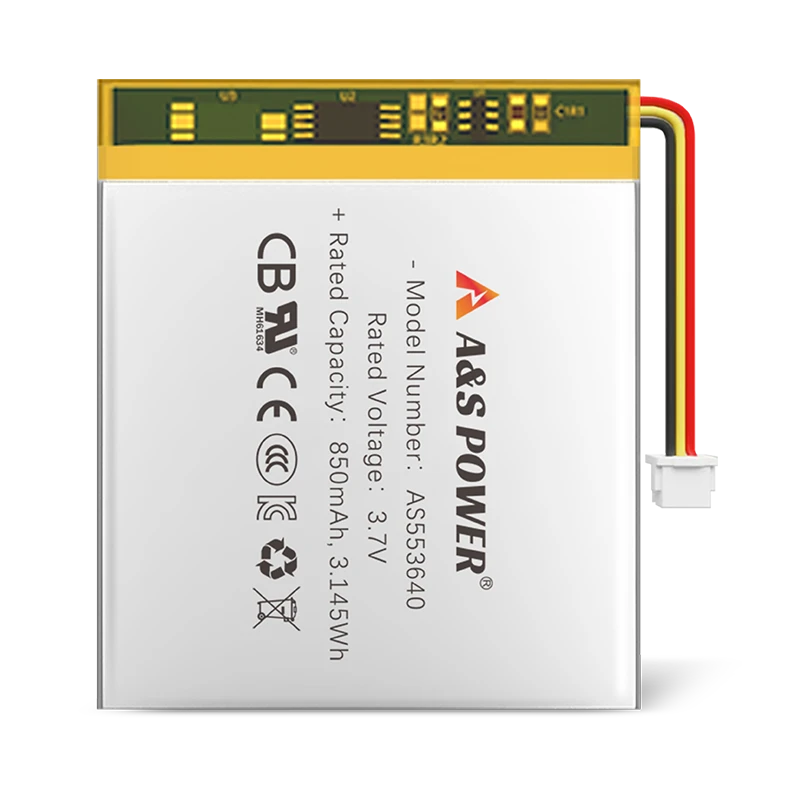
| AS502030 | 3.7V | 240mAh | 5.0mm | 20mm | 30mm |
| AS502248 | 3.7V | 500mAh | 5.0mm | 22mm | 48mm |
| AS503035 | 3.7V | 500mAh | 5.0mm | 30mm | 35mm |
| AS504552 | 3.7V | 1200mAh | 5.0mm | 45mm | 52mm |
| AS6060115 | 3.7V | 5000mAh | 6.2mm | 60.5mm | 117.5mm |
These examples demonstrate an important engineering principle: two batteries with exactly the same 3.7V nominal voltage can have completely different physical dimensions and capacities.
For products with limited internal space, this flexibility can be more valuable than simply choosing a larger standard cylindrical cell.
How to Read a LiPo Battery Size Code
Many LiPo batteries use a number such as 502030 to describe their approximate dimensions.
A common interpretation is:
- 50 = approximately 5.0 mm thickness
- 20 = approximately 20 mm width
- 30 = approximately 30 mm length
Therefore, a 502030 LiPo cell is generally associated with a size around 5 × 20 × 30 mm.
However, engineers should always verify the manufacturer's mechanical drawing because actual finished dimensions may differ slightly due to tabs, wires, connectors, protection circuits, insulation, or other construction details.
For example, the A&S Power AS502030 is specified as a 3.7V 240mAh LiPo battery with dimensions of approximately 5 × 20 × 30 mm and a cell weight of about 6 g.
Does a Bigger 3.7V Battery Always Have More Capacity?
No.
Battery capacity is measured in mAh, while physical size is measured in millimeters. Although a larger cell can often accommodate more active material, capacity also depends on cell chemistry, electrode construction, energy density, and design constraints.
For example, A&S Power's product listings include 3.7V LiPo cells ranging from very small capacities such as 80mAh to much larger 5000mAh designs.
This is why I recommend selecting a battery in this order:
- Determine the required voltage.
- Calculate the required operating current.
- Estimate the required runtime.
- Calculate the minimum capacity.
- Define the maximum battery dimensions.
- Check peak discharge requirements.
- Select the appropriate protection circuit and connector.
- Confirm charging and safety requirements.
A simple first estimate for capacity is:
Required capacity (mAh) ≈ Load current (mA) × operating time (hours)
For example, a device consuming 100mA continuously for 5 hours would theoretically require about 500mAh. In an actual product, I would allow additional margin because real-world runtime is affected by discharge rate, temperature, battery aging, conversion losses, and the usable voltage range.
How to Choose the Right 3.7V Battery Size
When I evaluate a battery design, I rarely start with capacity alone. I start with the complete electrical and mechanical requirements.
1. Check the Available Space
Measure the actual battery compartment, including clearance for wires, connectors, insulation, and protection circuitry.
A battery that technically fits the cell cavity may still be unsuitable if the connector or cable cannot be routed safely.
2. Match Capacity to Runtime
Higher mAh generally means more stored charge, but it usually requires more active material and therefore more space or weight.
The goal is not to choose the biggest battery. It is to choose the smallest battery that can reliably deliver the required energy.
3. Check Continuous and Peak Current
A battery with adequate mAh may still be unsuitable if the device has a high startup or pulse current.
This is particularly important for motors, wireless transmitters, pumps, actuators, and other devices with changing loads.
4. Select the Correct Protection System
Depending on the application, a battery may require protection against overcharge, over-discharge, overcurrent, or short circuit.
The protection design should be matched to the cell and the final device rather than treated as an afterthought.
For OEM battery development, I also recommend reviewing the applicable safety and transportation requirements early in the design process. Depending on the application and target market, standards such as IEC 62133 and UL 1642 may be relevant to battery safety, while UN 38.3 is important for the transportation of lithium cells and batteries.
5. Consider Custom LiPo Construction
If no standard battery fits the enclosure, custom LiPo design can solve the mechanical problem.
A custom pouch cell can be specified around the product's available length, width, and thickness. A&S Power's published product range illustrates how widely 3.7V LiPo dimensions can vary.
3.7V Battery Size for Different Applications
Different products tend to have different priorities.
| Application | Typical battery priority | Suitable battery approach |
| GPS tracker | Small size + sufficient runtime | Compact LiPo |
| Wearable | Thinness + low weight | Custom thin LiPo |
| Medical device | Reliability + certification | Custom LiPo or Li-ion |
| Power tool | High current + capacity | Cylindrical Li-ion pack |
| IoT sensor | Compact size + low power | Small LiPo |
| Portable instrument | Runtime + mechanical fit | Custom LiPo/Li-ion |
| High-power equipment | Current + thermal performance | Cylindrical Li-ion pack |
These are design directions rather than universal rules. The final battery should always be selected from the device's measured electrical load and mechanical envelope.
Why Custom 3.7V LiPo Batteries Are Important for OEM Products
For OEM manufacturers, the battery is often part of the mechanical design rather than an interchangeable component.
A standard 18650 may have excellent availability, but its cylindrical shape can waste valuable space inside a thin or irregular enclosure.
A custom LiPo pouch cell can instead use a rectangular area that would otherwise remain unused.
This is particularly useful for:
- Medical monitoring equipment
- GPS trackers
- Smart wearables
- Bluetooth devices
- Beauty equipment
- Portable instruments
- IoT terminals
- Handheld electronics
For example, A&S Power AS502030 provides a compact 3.7V, 240mAh solution in approximately 5 × 20 × 30 mm, while larger custom LiPo formats can provide substantially more capacity.
For OEM development, I also recommend discussing connector position, wire length, PCM/BMS requirements, charging current, operating temperature, certification, and transportation requirements at the beginning of the battery design process.
Conclusion
There is no single standard size for a 3.7V battery.
If you need a cylindrical lithium-ion cell, formats such as 14500, 18650, and 21700 provide established mechanical dimensions. If your product requires a thin, lightweight, or irregular battery shape, a custom 3.7V LiPo battery often provides significantly more design flexibility.
From my experience with battery development, the best battery is not necessarily the one with the highest mAh rating. It is the battery that balances voltage, capacity, dimensions, discharge performance, safety, charging requirements, lifetime, and certification within the actual product design.
For OEM projects, defining these requirements early can prevent costly enclosure changes later and makes it easier to move from prototype to reliable mass production.
Recommended Technical References
For engineers, OEM purchasing teams, and product developers, I recommend referring to recognized battery safety and transportation standards when evaluating a 3.7V lithium battery. These standards provide technical and regulatory context, but they do not define the physical size of a 3.7V battery.
- IEC 62133 — Safety requirements for portable sealed secondary cells and batteries.
- UL 1642 — Safety requirements for lithium batteries.
- UN 38.3 — Testing requirements for the safe transport of lithium cells and batteries.
FAQ: 3.7 Volt Battery Sizes
What is the most common 3.7V battery size?
The 18650 is one of the most widely used cylindrical 3.7V-class lithium-ion battery formats, measuring approximately 18 mm in diameter and 65 mm in length. However, 3.7V LiPo batteries do not have one universal size.
Is a 3.7V battery the same as a 4.2V battery?
No. A typical 3.7V lithium battery uses 3.7V as its nominal voltage, while its full-charge voltage is commonly around 4.2V. The charger and protection system must be designed for the specific cell specification.
What does 18650 mean?
The number 18650 generally indicates a cylindrical cell approximately 18 mm in diameter and 65 mm long. It describes the physical format rather than the battery's capacity.
What does 502030 mean on a LiPo battery?
A 502030 LiPo designation commonly indicates approximately 5.0 mm thickness, 20 mm width, and 30 mm length. Actual finished dimensions should be confirmed from the manufacturer's mechanical drawing.
Can I replace one 3.7V battery with another 3.7V battery?
Not necessarily. The replacement must also match capacity, dimensions, discharge current, charging requirements, connector, protection circuit, and the device's electrical specifications.
Is a 21700 better than an 18650?
Not automatically. A 21700 cell is physically larger and can offer higher capacity in many designs, but an 18650 may be the better choice when space is limited. The correct format depends on the application.
Are 3.7V LiPo batteries customizable?
Yes. LiPo pouch batteries are particularly suitable for customization because their length, width, thickness, capacity, connector, wires, and protection configuration can be designed around the application.
-

 May.2026.08.14A Complete Guide to 3.7 Volt Battery SizesLearn More
 -
 May.2026.08.13Mastering 3S LiPo Voltage: Your Ultimate 3S Charging GuideLearn More
 -
 May.2026.08.13What's the Difference Between Volts and Amps? A Beginner's GuideLearn More
 -
 May.2026.08.12Controlled Mug LiPo Battery: Custom Battery Solutions for Smart MugsLearn More
 -
 May.2026.08.11Custom Medical Timer LiPo Battery: Reliable Power Solution for Compact Medical DevicesLearn More