





How to Conduct Effective Cycle Testing for Custom Battery Packs
Quick Answer:
Effective cycle testing for custom battery packs requires controlled charge-discharge conditions, standardized test procedures, accurate environmental control, and continuous data analysis. By monitoring capacity retention, internal resistance, efficiency, temperature, and voltage behavior over hundreds or thousands of cycles, manufacturers can accurately predict battery lifespan, verify design reliability, and ensure compliance with international safety standards such as IEC 61960, IEC 62133, UL 2054, and UN38.3. Proper cycle testing enables OEMs to reduce warranty risks, improve product reliability, and optimize battery pack design before mass production.
Introduction
Custom battery packs power thousands of modern products—from portable medical equipment and industrial scanners to GPS trackers, robotics, and smart wearable devices. Regardless of the application, one question always determines whether a battery design is ready for production:
How long will it actually last in real-world use?
As a custom lithium battery manufacturer, we've learned that theoretical calculations alone cannot answer this question. The only reliable approach is comprehensive cycle testing, performed under controlled laboratory conditions that closely simulate actual operating environments.
Cycle testing reveals much more than a battery's lifespan. It exposes hidden design weaknesses, evaluates cell consistency, validates battery management systems (BMS), measures degradation rates, and helps engineers optimize performance before products reach customers.
In this guide, we'll explain how effective cycle testing is conducted, which parameters matter most, applicable international standards, common testing mistakes, and how OEMs can use test results to make better battery sourcing decisions.
What Is Battery Cycle Testing?
Battery cycle testing is a controlled process of repeatedly charging and discharging a battery pack while recording changes in electrical performance over time.
A complete cycle generally includes:
- Charging the battery according to specified charging protocols
- Allowing the battery to rest
- Discharging under controlled current
- Recording voltage, current, temperature, capacity, and resistance
- Repeating the process hundreds or thousands of times
The primary objective is to determine cycle life, which is commonly defined as the number of charge-discharge cycles completed before the battery capacity decreases to approximately 80% of its original rated capacity.
Depending on the application, testing may continue beyond this threshold to better understand long-term degradation characteristics.
Unlike a simple capacity test, cycle testing evaluates how the battery ages over time under realistic operating conditions.
Why Cycle Testing Matters for Custom Battery Packs
Every custom battery pack is unique.
Different products require different:
- Cell chemistries
- Charge rates
- Discharge currents
- Operating temperatures
- Mechanical designs
- Protection circuits
- Duty cycles
Because of these differences, manufacturers cannot rely solely on cell supplier specifications.
Instead, the complete battery pack—including cells, BMS, wiring, connectors, enclosure, and firmware—must be validated as an integrated system.
Proper cycle testing provides valuable insights into:
- Actual service life
- Capacity degradation trends
- Internal resistance growth
- Thermal stability
- Charging efficiency
- Voltage consistency
- Cell balancing effectiveness
- BMS protection performance
- Product reliability
- Warranty risk prediction
For OEMs, this information reduces uncertainty before launching products into the market.
Key Performance Indicators Measured During Cycle Testing
A professional cycle test measures far more than battery capacity. Multiple performance indicators are tracked throughout the battery's life to provide a complete picture of reliability and aging behavior.
| Parameter | Why It Matters | Typical Evaluation |
|---|---|---|
| Capacity Retention | Indicates remaining usable energy | ≥80% after target cycle count |
| Internal Resistance | Reflects aging and power loss | Lower increase is better |
| Coulombic Efficiency | Measures charge/discharge efficiency | Typically >99% for healthy Li-ion cells |
| Energy Efficiency | Evaluates usable output energy | Monitored throughout testing |
| Voltage Stability | Detects abnormal degradation | Stable discharge curve preferred |
| Temperature Rise | Assesses thermal management | Must remain within design limits |
| Cell Voltage Consistency | Indicates cell balancing quality | Minimal voltage deviation |
| Charge Time | Tracks charging performance changes | Should remain consistent |
| Discharge Runtime | Represents real-world endurance | Compared across lifecycle |
| Protection Circuit Response | Confirms BMS reliability | Protection functions verified |
These parameters allow engineers to identify subtle degradation long before complete battery failure occurs.
Typical Cycle Testing Conditions
To generate meaningful and repeatable results, cycle testing must be performed under controlled laboratory conditions. Variations in temperature, charging methods, or discharge rates can significantly affect measured battery life.
Below is an example of common testing conditions used for lithium-ion and lithium polymer battery packs.
| Test Item | Typical Condition |
|---|---|
| Ambient Temperature | 25°C ±2°C |
| Relative Humidity | 45–75% RH |
| Charge Method | Constant Current / Constant Voltage (CC/CV) |
| Charge Cutoff Voltage | According to cell specification |
| Discharge Method | Constant Current |
| Discharge Cutoff Voltage | Defined by battery design |
| Rest Time | 10–30 minutes between charge and discharge |
| Data Sampling | Continuous logging throughout testing |
| Cycle Count | 300–2,000+ cycles depending on application |
While these conditions are widely used for baseline evaluation, additional testing at high and low temperatures is often necessary for batteries intended for outdoor, industrial, or medical environments.
High-quality testing equipment with precise current control and accurate data acquisition is essential for obtaining reliable, repeatable results.
How to Conduct Effective Cycle Testing for Custom Battery Packs
Effective cycle testing is much more than repeatedly charging and discharging a battery. A well-designed test plan should replicate the battery's real operating conditions while maintaining strict control over variables that could influence the results.
Based on our experience developing custom lithium battery packs for medical devices, industrial equipment, GPS trackers, and smart electronics, we recommend the following eight-step testing process.
Step 1: Define the Testing Objective
Before connecting the battery to a cycler, determine what you want to validate.
Typical objectives include:
- Estimating battery lifespan
- Comparing different cell brands
- Evaluating a new battery design
- Verifying BMS functionality
- Validating customer specifications
- Accelerating product qualification
- Predicting warranty performance
Different objectives often require different testing profiles. For example, a wearable device battery may use shallow discharge cycles, while an industrial battery pack may undergo deep discharge testing at higher currents.
Clearly defining the objective prevents unnecessary testing and produces more meaningful results.
Step 2: Select Representative Battery Samples
Testing only one battery pack rarely provides statistically reliable data.
Instead, manufacturers typically evaluate multiple samples from the same production batch to assess manufacturing consistency.
Sample selection should consider:
- Cell production lot
- Battery pack assembly batch
- Connector configuration
- Protection circuit version
- Battery management firmware
- Manufacturing date
Testing multiple samples helps identify variations caused by production processes rather than battery design itself.
Step 3: Stabilize Environmental Conditions
Temperature is one of the most influential factors affecting lithium battery performance.
For baseline cycle life evaluation, batteries are commonly tested in a temperature-controlled chamber maintained at 25°C ±2°C.
Additional environmental testing may include:
- Low-temperature operation (-20°C)
- High-temperature storage (60°C)
- Thermal cycling
- High-humidity exposure
- Combined temperature and vibration testing
Maintaining stable environmental conditions ensures that performance changes are caused by battery aging rather than external variables.
Step 4: Apply the Correct Charge and Discharge Profile
The charging and discharging process should closely match the battery's intended application.
Typical parameters include:
Charging
- Constant Current (CC)
- Constant Voltage (CV)
- Specified cutoff current
- Rest period
Discharging
- Constant current discharge
- Defined cutoff voltage
- Controlled discharge rate (commonly 0.5C–1C)
- Cooling interval before the next cycle
Testing outside the recommended voltage or current limits may artificially shorten battery life and produce misleading results.
For specialized applications such as drones, power tools, or medical equipment, customized duty cycles often provide more realistic performance data than standard laboratory profiles.
Step 5: Continuously Monitor Key Performance Data
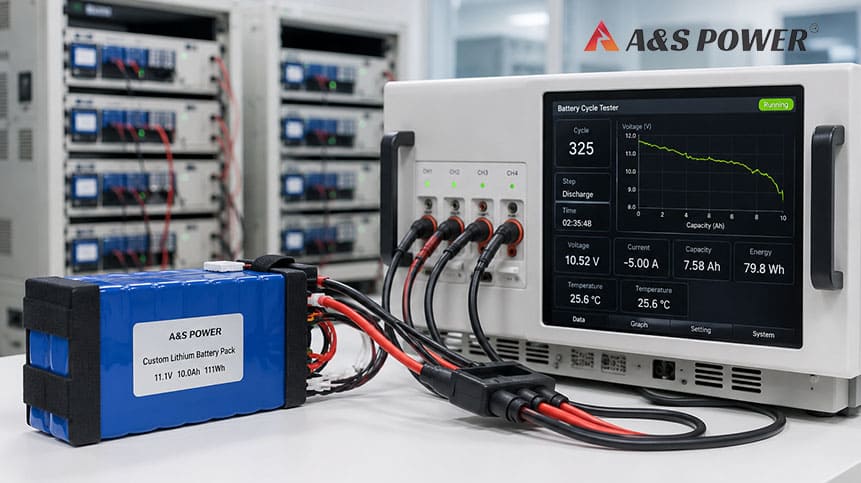
A professional battery cycler records hundreds of data points throughout every charge and discharge cycle.
Important parameters include:
- Capacity (Ah or mAh)
- Voltage curve
- Charge efficiency
- Discharge efficiency
- Internal resistance
- Surface temperature
- Cell voltage balance
- Cycle number
- Charging duration
- Discharging duration
Rather than focusing solely on the final cycle life, engineers analyze long-term performance trends to identify early signs of degradation.
For example, a gradual increase in internal resistance often appears long before significant capacity loss occurs.
Step 6: Evaluate Capacity Retention
Capacity retention is one of the most widely accepted indicators of battery health.
It compares the battery's remaining capacity with its original rated capacity throughout the testing process.
The calculation is straightforward:
Capacity Retention (%) = Remaining Capacity ÷ Initial Capacity × 100
Many lithium-ion batteries are considered to have reached the end of their useful service life when capacity falls to approximately 80% of the initial value.
However, some medical, aerospace, or industrial applications may require stricter acceptance criteria depending on reliability requirements.
Step 7: Analyze Battery Degradation Trends
Cycle testing should identify not only when performance declines but also why it declines.
Typical degradation mechanisms include:
- Growth of the solid electrolyte interphase (SEI)
- Loss of active lithium
- Electrode material fatigue
- Electrolyte decomposition
- Lithium plating caused by improper charging
- Increased internal resistance
- Mechanical stress from repeated expansion and contraction
Understanding these degradation mechanisms allows engineers to optimize:
- Cell selection
- Charging algorithms
- Thermal management
- Mechanical structure
- Protection circuit design
This analysis often leads to longer battery life without changing the overall battery size.
Step 8: Compare Results Against Design Requirements
The final step is determining whether the battery meets the original project specifications.
Typical evaluation criteria include:
| Evaluation Item | Typical Acceptance Criteria |
|---|---|
| Capacity Retention | ≥80% after target cycle count |
| Internal Resistance Increase | Within design limit |
| Cell Voltage Difference | Minimal deviation between cells |
| Temperature Rise | Within safe operating range |
| Charging Efficiency | Stable throughout testing |
| BMS Protection | Functions normally under all test conditions |
| Physical Appearance | No swelling, leakage, corrosion, or deformation |
| Safety Performance | No abnormal heating, smoke, or thermal events |
A battery pack that successfully meets these criteria is generally ready for further product validation or mass production.
Best Practices for Reliable Battery Cycle Testing
While testing equipment continues to improve, the accuracy of cycle life evaluation still depends heavily on proper testing methodology.
Based on industry experience, we recommend the following best practices:
- Test the complete battery pack rather than individual cells whenever possible.
- Use calibrated battery cyclers and regularly verify measurement accuracy.
- Allow adequate rest periods between charging and discharging to stabilize cell voltage.
- Record all environmental conditions, including temperature and humidity.
- Test multiple samples to account for manufacturing variation.
- Avoid interrupting long-term tests unless required by the test protocol.
- Analyze voltage curves and internal resistance trends in addition to capacity loss.
- Store raw test data for traceability and future product improvement.
- Repeat critical tests when significant design changes are introduced.
- Follow internationally recognized standards to ensure consistent and comparable results.
By combining disciplined testing procedures with comprehensive data analysis, manufacturers can identify potential issues early, reduce development costs, and deliver battery packs with more predictable long-term performance.
Common Mistakes That Reduce the Accuracy of Cycle Testing
Even with advanced battery cyclers, poor testing practices can produce misleading results. We've seen cases where a battery appeared to have a short lifespan simply because the test conditions did not reflect its intended application.
Below are some of the most common mistakes and their potential impact.
| Common Mistake | Potential Impact |
|---|---|
| Testing at unstable ambient temperatures | Inconsistent capacity and cycle life results |
| Using incorrect charge or discharge rates | Artificially accelerates battery aging |
| Evaluating only one battery sample | Results may not represent production consistency |
| Ignoring rest periods between cycles | Inaccurate voltage and capacity measurements |
| Focusing only on capacity retention | Misses early signs of degradation such as increasing internal resistance |
| Failing to calibrate test equipment | Measurement errors accumulate over long test periods |
| Not monitoring cell balancing | Hidden inconsistencies may lead to premature pack failure |
| Ending the test too early | Long-term degradation trends remain unknown |
Avoiding these issues helps ensure that cycle life data is both repeatable and meaningful, allowing engineers to make confident design decisions.
International Standards Related to Battery Cycle Testing
Although every battery application has unique requirements, internationally recognized standards provide a common framework for evaluating performance and safety.
The most frequently referenced standards include:
IEC 61960
IEC 61960 specifies performance testing methods for secondary lithium cells and batteries. It defines procedures for measuring capacity, energy efficiency, cycle life, and electrical characteristics under standardized laboratory conditions.
It is widely referenced when comparing the performance of lithium-ion cells used in portable electronic devices.
Cycle life testing is commonly performed according to internationally recognized standards such as IEC 61960, which defines standardized methods for evaluating the performance of rechargeable lithium batteries. For detailed technical information, refer to the IEC 61960 Battery Performance Standard (https://www.iec.ch).
IEC 62133
IEC 62133 focuses on the safety requirements for rechargeable lithium batteries used in portable equipment.
In addition to electrical safety, it includes mechanical, thermal, and environmental tests that help verify the reliability of battery packs under normal and abnormal operating conditions.
UL 2054
UL 2054 is a North American safety standard for household and commercial battery packs. It evaluates electrical protection, enclosure integrity, mechanical robustness, and resistance to abuse conditions.
Many OEM products entering the U.S. market require battery packs designed to comply with UL safety requirements.
Battery packs sold in North America are frequently evaluated against UL 2054 safety requirements. More information can be found on the official UL Solutions website (https://www.ul.com).
UN38.3
UN38.3 is mandatory for the transportation of lithium batteries by air, sea, rail, and road.
Although it is not a cycle life standard, passing UN38.3 confirms that a battery pack can safely withstand transportation-related stresses such as vibration, shock, altitude simulation, thermal cycling, and external short circuits before commercial shipment.
Lithium batteries intended for international shipment should comply with UN38.3 transportation requirements. The official UN Manual of Tests and Criteria is available from the United Nations Economic Commission for Europe (https://unece.org/transport/dangerous-goods).
Manufacturer-Specific Validation Protocols
In addition to international standards, many OEMs develop their own validation procedures based on actual product usage.
Examples include:
- High-rate pulse discharge testing for power tools
- Continuous low-current cycling for IoT devices
- Frequent partial-state-of-charge cycling for wearable electronics
- High-temperature endurance testing for automotive and industrial equipment
- Deep discharge validation for portable medical devices
These customized protocols often provide a more realistic assessment of field performance than standardized laboratory testing alone.
How OEMs Can Use Cycle Testing Results to Improve Product Development
Cycle testing is not simply a quality-control exercise. It is a valuable engineering tool that supports better product design and more informed business decisions.
Well-documented test data can help OEMs:
- Select the most suitable lithium cell chemistry for the application.
- Compare suppliers using objective performance metrics rather than nominal specifications.
- Optimize battery pack structure to improve thermal management and extend service life.
- Fine-tune charging and discharging strategies through Battery Management System (BMS) programming.
- Estimate product lifespan and warranty periods with greater confidence.
- Reduce the likelihood of costly field failures or product recalls.
- Demonstrate compliance during customer audits and regulatory reviews.
By incorporating cycle testing early in the product development process, manufacturers can identify potential issues before mass production, reducing both development time and long-term support costs.
Why Work with A&S Power for Custom Battery Pack Validation?
At A&S Power, we believe that a reliable battery begins with rigorous testing—not assumptions.
With more than 15 years of experience in custom lithium-ion battery and lithium polymer battery manufacturing, we support OEM customers through every stage of battery development, from prototype evaluation to mass production.
Our engineering approach includes:
- Comprehensive charge-discharge cycle testing
- Capacity and internal resistance verification
- Cell matching and consistency analysis
- Battery Management System (BMS) functional validation
- High- and low-temperature performance evaluation
- Mechanical reliability assessments
- Transportation and safety testing support
- Production traceability and quality documentation
Whether your application is a portable medical device, industrial handheld terminal, GPS tracker, smart wearable, or consumer electronic product, our validation process is designed to help reduce technical risk and improve long-term reliability.
Rather than relying solely on theoretical specifications, we provide data-driven insights that enable our customers to make confident engineering decisions.
Conclusion
Effective cycle testing is one of the most important steps in developing dependable custom battery packs. It provides measurable evidence of how a battery will perform over months or years of real-world use, helping manufacturers optimize design, improve safety, and predict service life with greater accuracy.
A comprehensive testing program should go beyond simply counting charge-discharge cycles. It should evaluate capacity retention, internal resistance, temperature behavior, voltage consistency, charging efficiency, and the interaction between cells and the Battery Management System under controlled conditions.
For OEMs, investing in thorough cycle testing early in the development process can significantly reduce warranty claims, enhance customer confidence, and accelerate product qualification.
As battery technologies continue to evolve, combining internationally recognized testing standards with application-specific validation remains the most effective way to deliver safe, reliable, and high-performance custom battery solutions.
FAQ
1. How is battery cycle life defined?
Battery cycle life is the number of complete charge-discharge cycles a battery can perform before its usable capacity decreases to a specified level, typically 80% of its original rated capacity.
2. Why is capacity retention more important than cycle count alone?
Cycle count only indicates how many charging cycles have occurred. Capacity retention shows how much usable energy remains, providing a more meaningful indicator of battery health and practical service life.
3. How many cycles should a custom lithium battery be tested?
The required number depends on the application. Consumer electronics may require several hundred cycles, while medical, industrial, or energy storage systems often undergo testing for 1,000 to 2,000 cycles or more.
4. Can higher charging currents shorten battery lifespan?
Yes. Charging at excessively high currents increases heat generation and accelerates chemical aging, which can reduce cycle life if the battery is not specifically designed for fast charging.
5. Why are temperature-controlled tests necessary?
Temperature has a significant impact on lithium battery performance and aging. Conducting tests under controlled environmental conditions ensures consistent, repeatable, and comparable results.
6. Should the Battery Management System (BMS) be included in cycle testing?
Absolutely. Since the BMS controls charging, discharging, balancing, and protection functions, testing the complete battery pack provides a more accurate representation of real-world performance than testing cells alone.
7. Which international standards are commonly referenced for cycle testing?
Common standards include IEC 61960 for performance evaluation, IEC 62133 for safety, UL 2054 for battery pack safety, and UN38.3 for transportation compliance. Depending on the product, additional customer-specific validation protocols may also apply.
8. How can OEMs compare battery suppliers using cycle testing data?
OEMs should review independently verified test reports that include capacity retention, internal resistance growth, temperature performance, test conditions, sample size, and compliance with recognized testing standards. Comparing these metrics provides a more objective assessment than relying solely on nominal specifications.
-

 May.2026.08.0521700 Battery Pack with BMS: Design, Safety and Custom SolutionsLearn More
 -
 May.2026.08.04Smart Beauty Equipment Battery Pack ManufacturerLearn More
 -
 May.2026.08.04High Reliability Polymer Battery for Handheld Dental DevicesLearn More
 -
 May.2026.08.04Ultra Thin Lithium Polymer Battery 0.4mm 0.5mm Custom GuideLearn More
 -
 May.2026.07.30Smoke Detector Battery Guide: Choosing the Right Battery for Reliable Fire ProtectionLearn More