




Replacement Lithium Battery for Hospital Breast Pumps Guide 2026
Replacement Lithium Battery for Hospital Breast Pumps – Everything You Need to Know
As someone working closely with OEM lithium battery solutions for medical devices, I’ve seen a clear trend over the past few years: hospital-grade breast pumps are becoming more portable, more efficient, and increasingly dependent on high-performance lithium battery systems.
In this article, I want to break down everything you need to know about replacement lithium battery for hospital breast pumps, including technical specifications, safety considerations, real-world hospital usage requirements, and how to choose the right replacement battery without risking device performance or patient safety.
This is not theoretical. It reflects actual engineering requirements, OEM production standards, and medical device integration experience.
Why Hospital Breast Pumps Rely on Lithium Battery Systems
Hospital breast pumps are not consumer-grade devices. They are designed for:
- NICU use
- Postpartum care units
- Lactation support centers
- Emergency and portable care environments
Because of these use cases, mobility and reliability are critical.
Key reasons lithium batteries are used:
- High energy density
Lithium-ion batteries store more energy in a compact size, enabling portable hospital-grade pumps. - Stable voltage output
Breast pumps require consistent suction cycles. Voltage drops can affect suction performance. - Rechargeability
Hospital devices run multiple cycles daily, making rechargeable systems essential. - Lightweight design
Medical staff often transport devices between rooms or wards.
Typical Specifications of Hospital Breast Pump Batteries
Based on common OEM medical device designs, replacement lithium battery packs typically follow these configurations:
| Parameter | Typical Range | Notes |
|---|---|---|
| Voltage | 7.4V / 11.1V | Depends on pump motor design |
| Capacity | 2000mAh – 6000mAh | Affects runtime |
| Chemistry | Li-ion / Li-Po | Medical-grade preferred |
| Cycle Life | 300–800 cycles | Depends on quality grade |
| Protection | BMS integrated | Overcharge/over-discharge protection |
From my experience working with OEM clients, most hospital breast pumps prioritize 7.4V Li-ion packs with integrated BMS protection circuits for safety compliance.
Key Safety Standards for Medical Battery Replacement
When replacing a lithium battery in a hospital breast pump, safety is not optional—it is regulatory.
Common compliance standards include:
- IEC 62133 (Portable sealed battery safety)
- UN38.3 (Transport safety for lithium batteries)
- CE certification (EU compliance)
- RoHS compliance (Hazardous substance restriction)
You can review IEC standards here:
IEC Standards Overview
Why this matters in hospitals:
A non-compliant battery can cause:
- Device overheating
- Incorrect suction pressure
- Unexpected shutdown during operation
- Safety risks for patients and staff
In hospital environments, even minor instability is unacceptable.
Common Failure Reasons in Breast Pump Batteries
From maintenance reports and OEM feedback, the most common reasons hospitals replace lithium batteries include:
1. Cycle aging
Lithium batteries naturally degrade after repeated charge cycles.
2. Deep discharge damage
Leaving devices unused for long periods can damage cells.
3. Internal resistance increase
This reduces runtime and causes unstable voltage output.
4. BMS failure
Protection circuit malfunction leads to charging issues.
5. Environmental stress
High temperature sterilization environments can accelerate aging.
How to Choose the Right Replacement Battery
Selecting the correct battery is critical for device safety and performance.
1. Match voltage exactly
Never substitute voltage levels. A 7.4V pump must remain 7.4V.
2. Check physical compatibility
Battery housing must match internal pump structure.
3. Verify connector type
Hospitals often overlook connector mismatches, causing downtime.
4. Ensure medical-grade certification
Always verify compliance documentation.
5. Confirm OEM/ODM support
For bulk hospital procurement, OEM customization is often required.
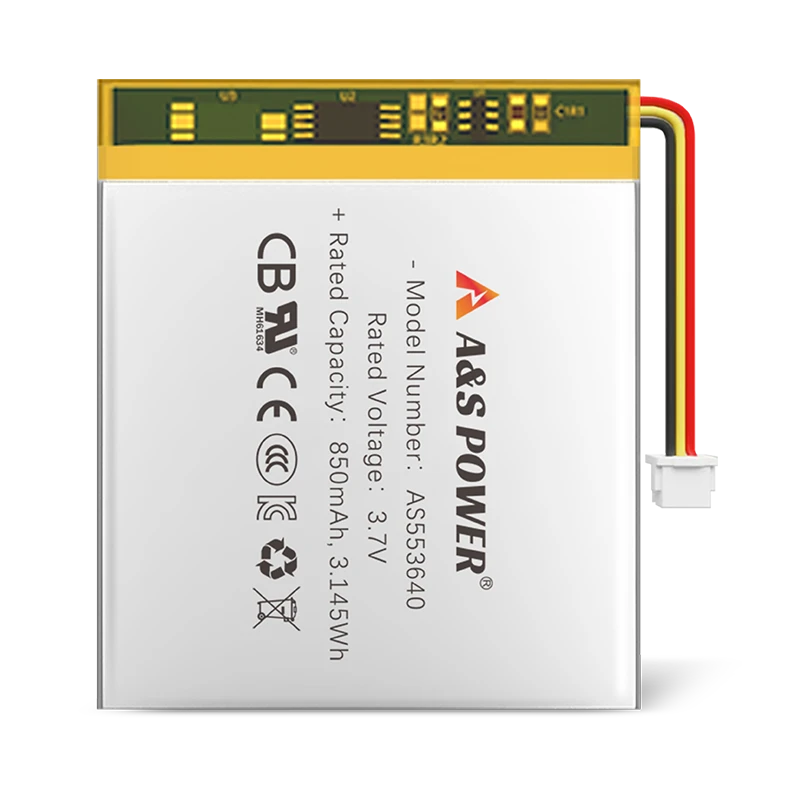
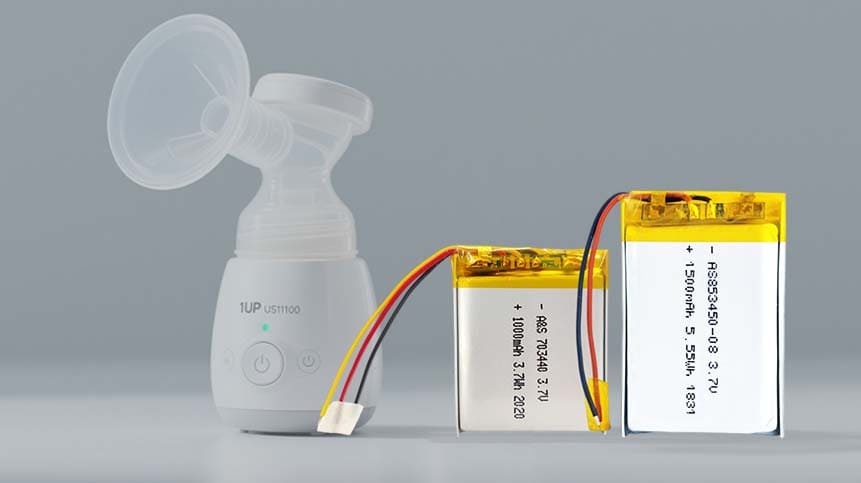
AS703440 — 3.7V 1000mAh LiPo Battery
Certifications: UL1642 / UL2054 / IEC62133 CB / UN38.3 / CE / RoHS
Ideal for compact hospital breast pumps and wearable medical devices requiring lightweight design.
AS853450 — 3.7V 1500mAh LiPo Battery
Certifications: UL1642 / IEC62133 CB / UN38.3 / CE / KC / RoHS
Designed for hospital-grade breast pumps requiring longer runtime and stable discharge performance.
Real-World Hospital Usage Requirements
Hospital breast pumps are used differently from home-use devices.
Usage pattern differences:
- Multiple patients per day
- Continuous sterilization cycles
- High duty cycle operation
- Emergency portability requirements
Battery performance expectations:
- Minimum 4–8 hours runtime per charge
- Fast recharge (2–4 hours typical)
- Stable output under load
- Low self-discharge rate
Battery Performance Comparison Table
| Battery Type | Stability | Lifespan | Safety Level | Hospital Suitability |
|---|---|---|---|---|
| Standard Li-ion | Medium | 300 cycles | Medium | Limited |
| Medical-grade Li-ion | High | 500–800 cycles | High | Recommended |
| Li-Po flexible pack | High | 400–700 cycles | High | Excellent |
Medical-grade lithium-ion solutions remain the most widely used in hospital breast pump systems due to stability and certification availability.
Maintenance Tips to Extend Battery Life
Based on OEM maintenance recommendations, here are practical guidelines:
1. Avoid full discharge cycles
Recharge when battery reaches ~20–30%.
2. Store at moderate temperature
Ideal storage: 15°C–25°C.
3. Use original chargers only
Mismatch charging causes degradation.
4. Regular calibration
Full charge-discharge cycle every 2–3 months helps recalibrate battery management.
5. Avoid humidity exposure
Moisture can damage internal PCB protection systems.
OEM Replacement Battery Solutions for Hospitals
Many hospitals now prefer OEM customized battery packs instead of generic replacements.
Advantages:
- Exact fit for device model
- Certified safety documentation
- Longer lifecycle options
- Custom capacity design
- Better supply chain stability
At A&S Power, we often design customized lithium battery packs for medical devices such as breast pumps, ECG machines, and portable diagnostic equipment.
AS703440 Application: Compact wearable breast pumps requiring lightweight integration.
AS853450 Application: Hospital-grade systems requiring long operation cycles.
OEM customization options include connector type, BMS design, capacity tuning, and cable configuration.
Industry Trend – Smarter Medical Battery Systems
The medical battery industry is evolving toward:
- Smart BMS integration
- Bluetooth battery monitoring
- Real-time charge status tracking
- Ultra-safe pouch cell structures
Hospitals increasingly demand predictive maintenance capabilities to reduce downtime.
FAQ – Replacement Lithium Battery for Hospital Breast Pumps
Q1: How long does a hospital breast pump battery last?
Most medical-grade lithium batteries last between 2–4 years depending on usage frequency and charge cycles.
Q2: Can I replace a hospital breast pump battery with a generic lithium battery?
It is not recommended. Medical devices require certified batteries with matching voltage, BMS protection, and compliance documentation.
Q3: What is the safest battery type for hospital breast pumps?
Medical-grade Li-ion batteries with integrated BMS protection are the safest and most widely used.
Q4: How do I know if my breast pump battery needs replacement?
Common signs include reduced runtime, overheating, slow charging, or sudden shutdowns.
Q5: Are OEM replacement batteries better than generic ones?
Yes. OEM batteries ensure exact compatibility, higher safety compliance, and longer service life.
-

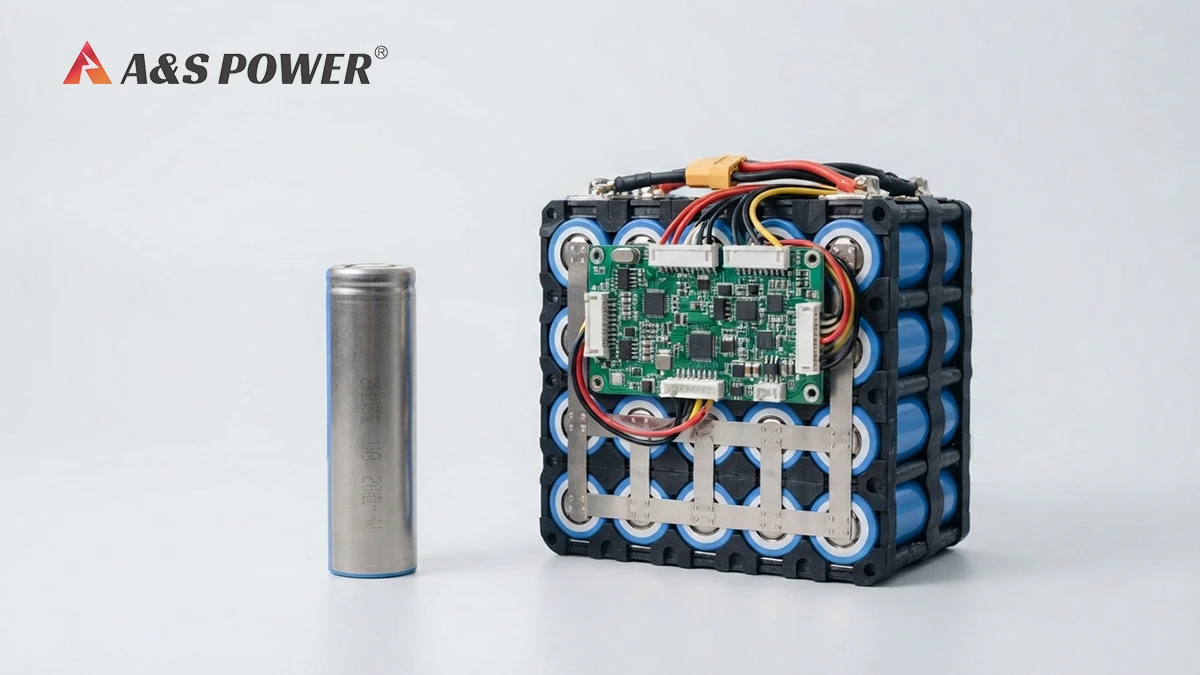 May.2026.08.0521700 Battery Pack with BMS: Design, Safety and Custom SolutionsLearn More
 -
 May.2026.08.04Smart Beauty Equipment Battery Pack ManufacturerLearn More
 -
 May.2026.08.04High Reliability Polymer Battery for Handheld Dental DevicesLearn More
 -
 May.2026.08.04Ultra Thin Lithium Polymer Battery 0.4mm 0.5mm Custom GuideLearn More
 -
 May.2026.07.30Smoke Detector Battery Guide: Choosing the Right Battery for Reliable Fire ProtectionLearn More