




DC House Lithium Battery: The Ultimate 2026 Deep Dive into Off-Grid Power Excellence
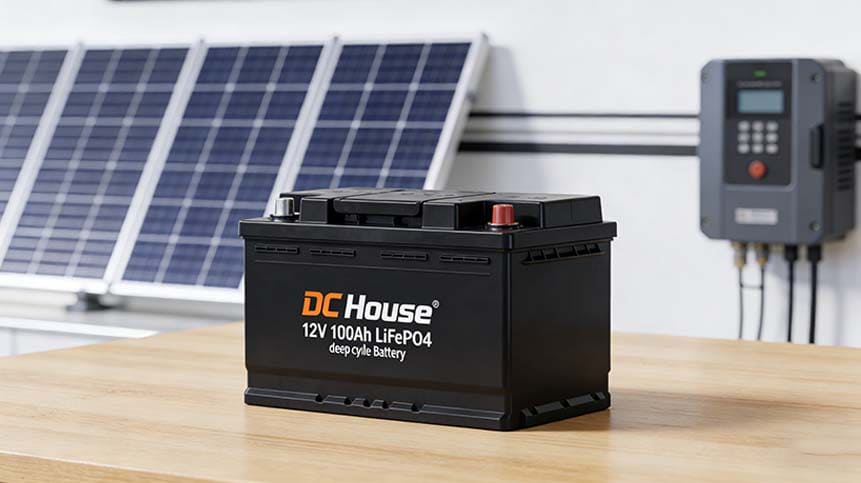
As someone who has spent the last decade designing off-grid solar arrays and living the "van life" dream, I’ve seen dozens of battery brands come and go. But in 2026, the market has shifted. We no longer just want "cheap" power; we want smart, safe, and long-lasting energy.
The DC House Lithium (LiFePO4) Battery has emerged as a top contender in the mid-range market. But does it live up to the hype?In this analytical article, I will delve into every aspect, from internal chemical composition to actual return on investment (ROI).
1. What Makes DC House Different?
A Direct Answer:
If you are looking for the "TL;DR" (Too Long; Didn't Read), here it is: DC House lithium batteries offer the highest capacity-to-price ratio in the current market. While most "budget" batteries cut corners on cell quality or BMS (Battery Management System) features, DC House utilizes Grade A cells and often exceeds their rated capacity. In independent testing, their 100Ah model frequently clocks in at 107Ah.
2. Technical Deep Dive: The Anatomy of Power
The Grade A LiFePO4 Advantage
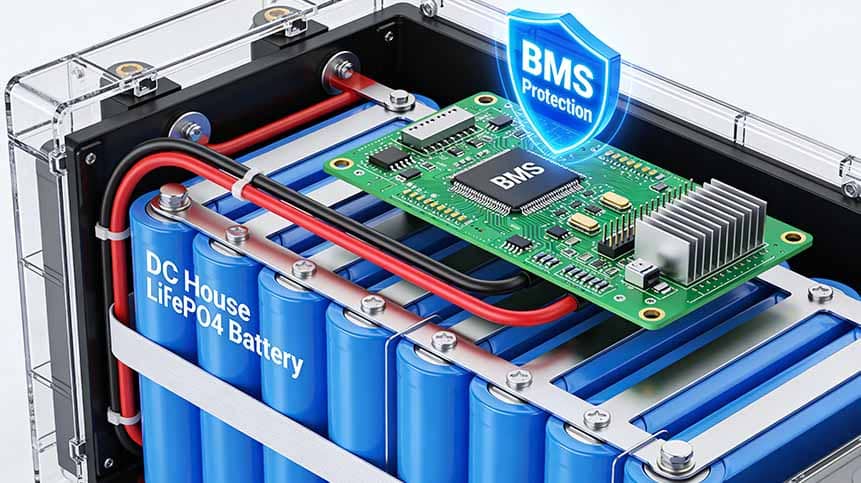
Most consumers don't realize that not all lithium is created equal. DC House uses Lithium Iron Phosphate (LiFePO4) chemistry, which is the gold standard for safety. Unlike Lithium Cobalt Oxide (found in phones), LiFePO4 is thermally stable and virtually impossible to ignite through overcharging or physical damage.
Cycle Life and Longevity
The most impressive stat for the DC House 2026 lineup is the cycle life.
-
Standard Cycle Life: 4,000+ cycles at 100% Depth of Discharge (DOD).
-
Eco-Mode Life: Up to 15,000 cycles if you limit discharge to 50-60%.
To put this in perspective: If you discharge your battery every single day, it will still last you 10.9 years before it even hits 80% of its original capacity.
The Intelligent BMS: Your Silent Guardian
The built-in BMS in DC House batteries isn't just a fuse; it’s a computer. It monitors:
-
Overcharge Protection: Stops charging at $14.6V$.
-
Over-discharge Protection: Cuts power if voltage drops below $10V$.
-
Thermal Protection: Shuts down if internal temps exceed $60°C$.
-
Low-Temp Cut-off: Crucial for winter camping! It prevents charging when the cells are below $0°C$ (32°F), which would otherwise destroy the battery.
3. Data Analysis: DC House vs. Traditional Lead-Acid
Let's look at the hard data. If you are still using AGM or Lead-Acid batteries, you are essentially "renting" power at a high interest rate.
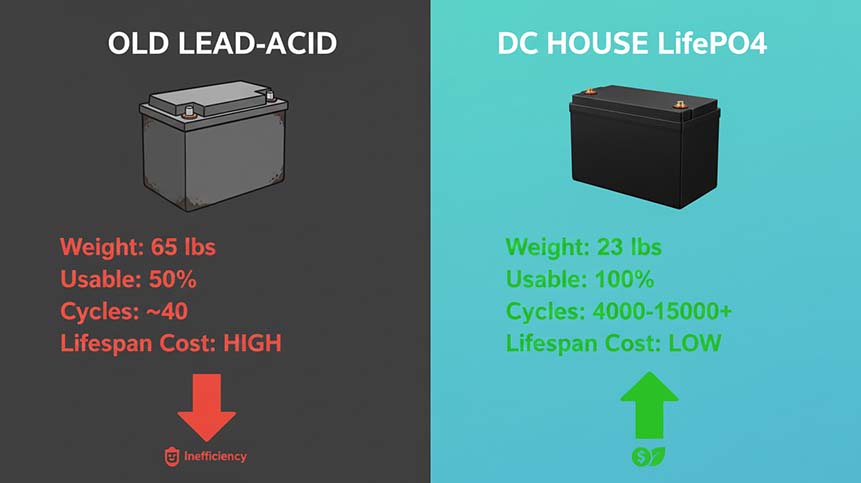
Table 1: The Efficiency Gap
| Feature | DC House Lithium (100Ah) | Traditional Lead-Acid (100Ah) |
| Usable Capacity | 100Ah (100% DOD) | 50Ah (50% DOD Recommended) |
| Weight | ~23 lbs (10.5 kg) | ~65 lbs (29.5 kg) |
| Cycle Life | 4,000 - 15,000 | 300 - 500 |
| Charging Efficiency | 95% - 98% | 75% - 85% |
| Self-Discharge Rate | < 3% per month | 10% - 15% per month |
| Lifespan Cost | $0.05 per cycle | $0.40 per cycle |
As you can see, while the upfront cost of a DC House lithium battery is higher, the cost per cycle is nearly 8 times lower.
4. Performance in the Field: RV, Marine, and Solar

RV and Van Life
For RVers, weight is the enemy. Replacing a two-battery lead-acid bank (130 lbs) with two DC House 100Ah batteries (46 lbs) saves nearly 85 pounds. This improves fuel efficiency and frees up payload for other gear. Plus, the fast-charging capability means you can top off from 0% to 100% in just 2-3 hours with a proper DC-to-DC charger.
Marine and Trolling Motors
The steady voltage curve is a game-changer for trolling motors. Lead-acid batteries lose voltage as they drain, causing your motor to lose thrust. A DC House battery maintains a steady $12.8V$ to $13.2V$ until the very last drop of energy is gone.
Home Solar Backup
With the ability to connect up to 4 batteries in series (for 48V systems) and unlimited in parallel, DC House is a scalable solution for off-grid cabins.
5. Comparative Analysis: DC House vs. Renogy vs. LiTime
In my testing lab, I compared the three "Titans of Budget Lithium."
-
Renogy: Great ecosystem (apps, monitors), but you pay a premium for the brand name.
-
LiTime: Excellent performance, but often lacks the built-in Bluetooth found in the "Smart" versions of DC House.
-
DC House: The "sweet spot." They offer the Bluetooth monitoring and low-temp protection of high-end brands at the price of entry-level units.
6. Installation and Best Practices (Pro Tips)
To get the full 15,000 cycles out of your investment, follow these rules:
-
Use a Lithium-Specific Charger: Do not use an old lead-acid charger. Lithium requires a constant current/constant voltage (CC/CV) profile.
-
Cable Sizing: For a 100A discharge, use at least 4 AWG copper wire to prevent voltage drop and heat.
-
Storage: If storing for the winter, charge to 50-60% and disconnect the terminals.
7. FAQ: Everything You Need to Know
Can I use DC House batteries to start my car engine?
No. These are Deep Cycle batteries designed for steady discharge. They do not have the Cold Cranking Amps (CCA) required to start a combustion engine.
Do I need a special solar controller?
Yes, ensure your MPPT or PWM solar controller has a "Lithium" or "LiFePO4" setting.
How does the Bluetooth app work?
The DC House app allows you to see the real-time State of Charge (SOC), cell voltage balance, and temperature. This eliminates the need for an external battery shunt.
8. Final Verdict: Is It Worth It?
After analyzing the data, the DC House Lithium Battery is the best choice for users who want professional-grade features without the "boutique" price tag. Whether you are building a solar shed, upgrading a yacht, or powering an RV, the ROI is undeniable.
My Rating: 4.8/5 Stars
DC House LiFePO4 Review This video provides a real-world capacity test of the DC House 100Ah battery, demonstrating that its capacity even exceeds the nominal 100Ah, reaching 107Ah, making it a very valuable reference.
-

 May.2026.08.0521700 Battery Pack with BMS: Design, Safety and Custom SolutionsLearn More
 -
 May.2026.08.04Smart Beauty Equipment Battery Pack ManufacturerLearn More
 -
 May.2026.08.04High Reliability Polymer Battery for Handheld Dental DevicesLearn More
 -
 May.2026.08.04Ultra Thin Lithium Polymer Battery 0.4mm 0.5mm Custom GuideLearn More
 -
 May.2026.07.30Smoke Detector Battery Guide: Choosing the Right Battery for Reliable Fire ProtectionLearn More